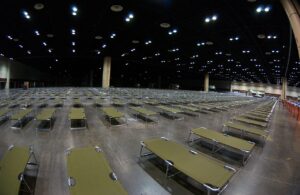
Every emergency plan has two halves. One is leaving: the evacuation, the go-bag, the route out. The other, quieter half is staying, and it is the one most people never plan for. Shelter-in-place means making your home the safest place to be and hunkering down until a threat passes. For a surprising number of emergencies, from a chemical spill to a winter storm to civil unrest, staying put is not the fallback. It is the correct answer, and evacuating unnecessarily in these scenarios can put a family in more danger than staying home ever would.
When to stay and when to go
The decision is not a matter of nerve. It follows the nature of the threat.
- Shelter in place when the danger is outside and moving away from it would put you in more of it: a hazardous material release, extreme weather already on top of you, unrest in the streets, or an official order to stay inside.
- Evacuate when the danger is coming toward your home and there is time to get ahead of it: a wildfire, a rising flood, a hurricane with days of warning. Our evacuation planning guide covers that half.
The single most dangerous choice is to freeze and make no decision at all. Know in advance which threats in your area call for which response, and the moment will not catch you flat-footed. As a rule of thumb, if you can hear official guidance clearly (radio, a wireless emergency alert, a knock from authorities) it will almost always tell you directly which of the two to do, so a working radio is as much a decision-making tool as a comfort item.
Get inside, stay inside, stay tuned
For airborne hazards, the official guidance used by emergency management agencies nationwide is three short phrases: get inside, stay inside, and stay tuned. The walls of your home are remarkably good protection, and the goal is to put as much building between you and the outside air as possible while you wait for real information.
Keep the phone and the radio alive

Affiliate note: buy through these links and ThisTracks may earn a small commission at no extra cost to you. We only list gear that is in stock and that we would carry ourselves.
Sealing a room, step by step
For a chemical or airborne threat, pick an interior room, ideally one with few windows and a water source. Shut off anything that pulls outside air in: furnaces, air conditioners, and exhaust fans. Close and lock windows and doors, because locking seals them tighter. Seal gaps around the door and any vents with plastic sheeting and duct tape. Bring in your emergency supplies and a battery radio, and wait for the official all-clear rather than guessing. A room of roughly ten feet by ten feet with an eight-foot ceiling holds enough air for about five hours per person before carbon dioxide buildup becomes a concern, so cracking the seal briefly after several hours if there is no update is a reasonable middle ground rather than staying sealed indefinitely with no information.
What sheltering in place requires
Staying put comfortably for two weeks is exactly what your stored water and food are for. On top of that base, a shelter-in-place plan needs a few specific things:
| Need | Why it matters |
|---|---|
| Information | Battery or hand-crank radio for official updates when networks are down |
| Light and warmth | No-grid, no-flame options for extended indoor stays |
| Sanitation | Heavy trash bags, a bucket, cleanliness supplies if water is off |
| Sealed-room kit | Pre-cut plastic sheeting and tape, labeled and ready |
- Information. A battery or hand-crank radio so you can hear official instructions when the internet and cell networks are down or overwhelmed.
- Light and warmth that do not require the grid or an open flame indoors.
- Sanitation. If the water is off, you need a plan for waste: heavy trash bags, a bucket, and some way to keep things clean, because disease spreads fast when sanitation fails.
- A sealed-room kit of plastic sheeting and duct tape, pre-cut and labeled so you are not measuring windows during an emergency.
Warmth without the grid

Affiliate note: buy through this link and ThisTracks may earn a small commission at no extra cost to you. We only list gear that is in stock and that we would carry ourselves.
The rule that saves lives every winter
Whatever the emergency, never bring an open flame or a fuel-burning device inside a sealed home for heat. No charcoal, no camp stove, no generator indoors or in an attached garage. Carbon monoxide is invisible and silent, and it kills whole families who were trying to stay warm, a pattern that spikes predictably every winter after major power outages. Warmth indoors comes from clothing, blankets, body heat, and a small closed-off room, never from combustion. A battery-powered carbon monoxide detector is inexpensive and worth having in any home that might ever run a generator nearby or use alternate heat sources.
Sheltering in place also overlaps with two of the most specific threats we cover: a radiological event, where the walls of your home are literal protection, and civil unrest, where the safest move is usually to be somewhere else, at home, and quiet.
Practicing the shelter-in-place decision
Because the stay-or-go decision has to happen fast and under pressure, it is worth rehearsing as its own drill, separate from your evacuation drill. Pick a random evening and ask each adult in the house: if the local news reported a chemical spill on the highway a mile away right now, what would you actually do in the next five minutes? Walk through sealing the room together once, even without a real threat, so the plastic sheeting is pre-cut, the tape is where you think it is, and everyone knows which room and why. A family that has physically practiced the seal-the-room steps once moves in silence and under two minutes during the real thing; a family that has only read about it tends to spend the first ten minutes arguing about which room to use.
Common questions
How do I know when it is safe to unseal the room?
Wait for an official all-clear from local authorities via radio, official alert, or emergency broadcast rather than guessing based on smell or how much time has passed. Chemical and radiological hazards are frequently undetectable by human senses, which is exactly why the official all-clear exists as a separate, authoritative signal.
What if I live in an apartment with no good interior room?
Choose the room farthest from exterior walls and windows, typically a bathroom or a closet-adjacent hallway, and focus extra effort on sealing the gaps around the door, since apartments often have less air volume to work with. A bathroom has the added benefit of a water source and often fewer windows than other rooms.
Do I need different supplies for a shelter-in-place event versus a multi-day power outage?
Mostly the same supplies serve both, since both require water, food, light, warmth, sanitation, and information without depending on outside resources. The main addition for a specifically airborne or chemical threat is the sealed-room kit, which a routine power outage does not require.
Shelter-in-place, condensed
- Stay when the threat is outside; leave when it is coming toward you. Never freeze.
- For airborne hazards: get inside, stay inside, stay tuned.
- Seal one interior room with pre-cut plastic and tape; shut off air intake.
- Stock information, light, warmth, and sanitation, not just food and water.
- Never burn anything indoors for heat. Ever.
Sheltering in place is not hiding and hoping. It is a deliberate, prepared response that turns your home into the safest room in the emergency. Plan both halves, staying and leaving, and you are ready for whichever one the situation demands.