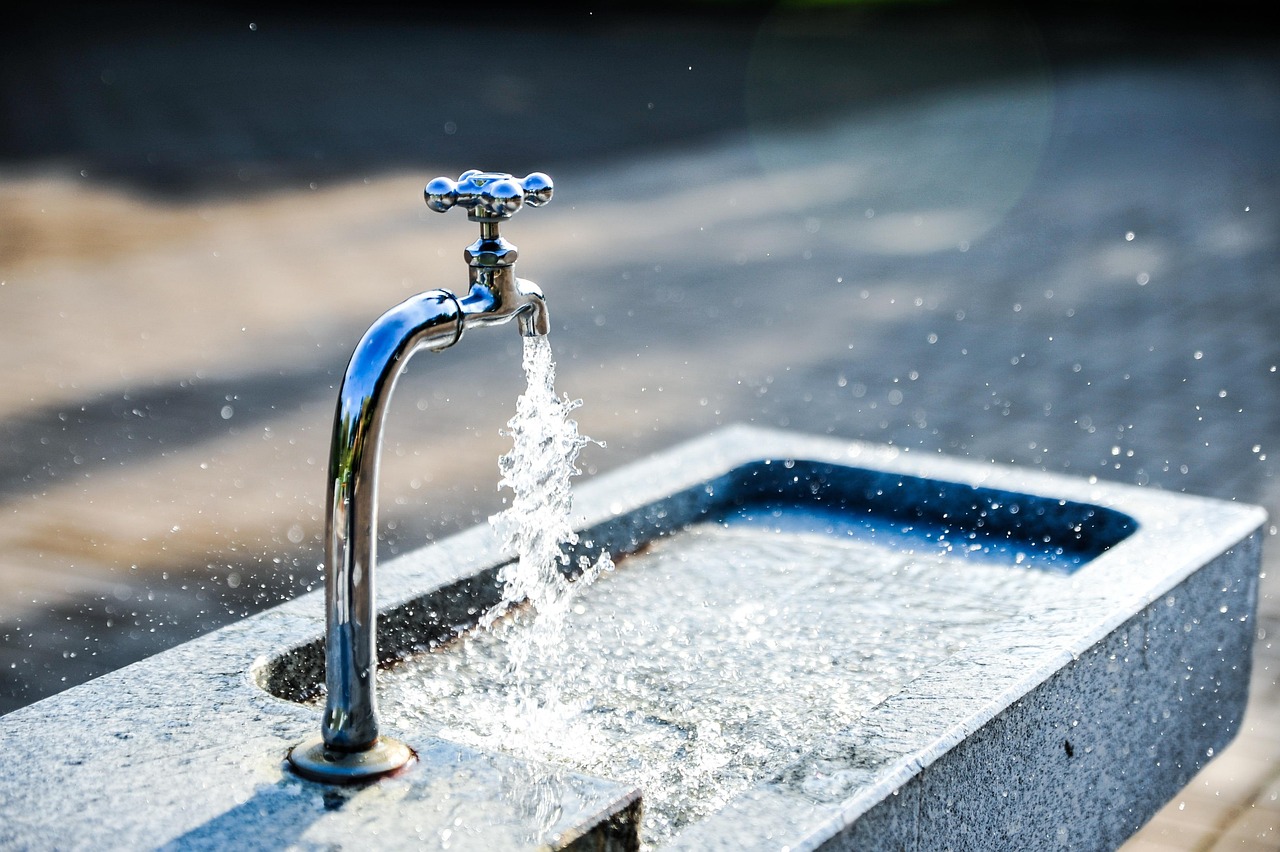
Almost everything written about water preparedness assumes the tap has stopped. Filtering from a creek, storing barrels in the basement, catching rain off a roof: all of it answers the question of what to do when nothing comes out of the faucet. That is the dramatic failure, and it is also the rare one. The far more common failure is that water keeps coming out of the faucet and something in it should not be there. That version arrives with a robocall or a notice on a door hanger, it lasts anywhere from a day to permanently, and most households handle it badly because nobody ever taught them the difference between the kinds of notice they might receive.
This article is about the water that comes out of a tap. It is the half of water preparedness that gets skipped, and it is the half that most people will actually use.
The single most important distinction: boil versus do not drink
Utilities issue advisories in categories, and the categories are not interchangeable. Confusing them is the most consequential water mistake an American household is likely to make, because the correct response to one is actively harmful in another.
A boil water advisory means the utility has reason to believe the water may carry microbial contamination: bacteria, viruses, or protozoa. Causes are usually mechanical, such as a main break that dropped system pressure and may have let groundwater in, a pump failure, or a positive coliform sample. The response is to bring water to a rolling boil for one minute, three minutes above 6,500 feet of elevation, and use it for drinking, cooking, ice, brushing teeth, and washing produce. Boiling works here because heat destroys living organisms.
A do-not-drink advisory means the contaminant is chemical. Nitrate, lead, solvents, fuel, an industrial spill, an over-fed treatment chemical, an algal toxin. Do not boil the water. Boiling removes water as steam and leaves the contaminant behind in what remains, so a pot of nitrate-contaminated water that boils down by a fifth is now a fifth more concentrated than when you started. Boiling makes chemical contamination worse. In a do-not-drink situation the only correct response is to use a different source entirely, which means stored water or bottled water, and to follow the utility’s specific guidance about whether the water is still safe for bathing and laundry.
A do-not-use advisory is the most serious and the least common. It means the water should not touch you at all: no bathing, no handwashing, no laundry, often no flushing depending on the contaminant. These get issued for severe chemical contamination where skin contact or inhaling the vapor in a hot shower is itself a hazard.
If you take one thing from this article, take this: boiling is the answer to germs and the wrong answer to chemicals. Read which kind of notice you received before you do anything else. Utilities state it plainly in the notice, and the reason they do is that this exact confusion has hurt people.
How to find out what is actually in your water
If you are on a public system, your utility is required to publish an annual water quality report, usually called a Consumer Confidence Report, and it is normally out by the first of July covering the prior year. It is public, it is free, and almost nobody reads it. Search your utility’s name plus “consumer confidence report” and you will have it in under a minute.
Reading one is less intimidating than it looks if you know what you are looking for. Skip to the detected contaminants table. Each row gives the contaminant, the level detected, and the legal limit. Three things are worth your attention. First, any row where the detected level is close to the limit rather than far below it, because that is a system with little margin. Second, the section on lead, which normally reports the ninetieth percentile result from sampling, meaning ninety percent of sampled homes were at or below that number. Third, any violation notices, which are required to be disclosed.
Understand the report’s blind spot, though, and it is a large one. The Consumer Confidence Report describes the water the utility produced. It does not describe the water arriving at your kitchen sink, because between the treatment plant and your glass sits a service line and your own household plumbing, and for lead that is where nearly all the risk lives.
Lead: an infrastructure problem with a household answer
Lead almost never comes from the source water or the treatment plant. It comes from the pipe, the solder, or the brass fixture between the water main and your tap. Milwaukee alone still has roughly 65,000 lead service lines in the ground, and it is far from unusual among older American cities. Replacement programs are underway nationally, but they are measured in years and in some cities in decades.
A few practical points do most of the work here. Lead is not removed by boiling, and boiling concentrates it, so the reflex response is again the wrong one. Hot water dissolves lead more readily than cold, so water for drinking, cooking, or making baby formula should always be drawn from the cold tap and heated afterward rather than drawn hot. Water that has been sitting in the pipe overnight has had the longest contact with it, so running the cold tap for thirty seconds to two minutes after a long idle period flushes the worst of it, and you can use that flush water for plants or dishes rather than pouring it away.
Beyond that, find out what your service line is actually made of. Many utilities now publish a searchable inventory by address, and if yours does not, the scratch test on the pipe where it enters the house is the classic check: lead is soft, scratches to a shiny silver, and is not magnetic. If you have lead, a filter certified for lead removal on the kitchen tap is a genuinely good investment, and the next section explains how to tell which ones actually do it.
PFAS: the contaminant that changes how you should think about filters
PFAS are a family of thousands of synthetic compounds used since the 1940s in nonstick coatings, stain and water repellents, food packaging, and firefighting foam. They are called forever chemicals because the carbon-fluorine bond that makes them useful also makes them extraordinarily resistant to breaking down, in the environment or in a human body.
The Wisconsin picture is instructive precisely because Wisconsin is not unusual. When the Milwaukee Journal Sentinel tested tap water from forty homes across the state, roughly thirty percent had at least one PFAS compound at a level above federal recommendations. Contamination clusters near airports, military installations, fire training grounds, paper mills, and landfills, because those are where firefighting foam and industrial waste concentrated, and it moves through groundwater, which is why private wells near those sites often test higher than nearby municipal systems.
Here is why PFAS matters to preparedness thinking well beyond the health question. It breaks the mental model most of us carry about what a filter is. We think of filtration as straining: a barrier with holes small enough to catch the bad thing. That model works for sediment, bacteria, and protozoa, all of which are physically large. PFAS molecules are dissolved. They are, functionally, part of the water. Nothing strains them out, they are unaffected by boiling, and they are unaffected by every chemical disinfectant. Removing them requires a fundamentally different mechanism: adsorption onto activated carbon, capture by an ion exchange resin, or physical rejection by a reverse osmosis membrane.
Reading filter certifications, which is the actual skill
Because there is no such thing as a filter that removes everything, the useful skill is not choosing a brand. It is matching the certification to the contaminant you actually have. American filters are tested against NSF/ANSI standards, and the numbers are the whole story.
NSF/ANSI 42 is aesthetic. Chlorine taste, odor, some particulates. It makes water pleasant. It is not a health claim, and this is the certification most inexpensive pitcher filters carry.
NSF/ANSI 53 is the health-effects standard, and it is the one that matters for most households. Certification is granted contaminant by contaminant, so a filter is not simply “53 certified”, it is certified under 53 for lead, or for cysts, or for particular volatile organic compounds. Read the performance data sheet and look for the specific contaminant you care about.
NSF/ANSI 58 covers reverse osmosis systems, which are the most thorough option available at household scale and the usual answer where the contaminant list is long or unknown.
NSF/ANSI 401 covers incidental compounds including some pharmaceuticals and pesticides.
NSF/ANSI P473 is the protocol specifically for PFOA and PFOS, the two most studied PFAS compounds. If PFAS is your concern, this is the marking to look for, and its absence is meaningful.
Two warnings. A filter only performs as certified while its media is fresh, and an exhausted carbon filter can release accumulated contaminants back into the water, so cartridge replacement schedules are a safety matter rather than a maintenance suggestion. And “filters 99.99 percent of contaminants” on a box means nothing at all without a certification and a named contaminant behind it.
Why your camping filter will not help here
This deserves saying directly, because it is a mistake we see constantly and it is the reason this article does not recommend a product.
The pocket filter straws and squeeze filters that preppers own, and that we have written about in our guide to portable water purifiers, are hollow-fiber membranes with pores in the neighborhood of 0.1 to 0.2 microns. They are excellent at what they were designed for, which is removing bacteria and protozoa such as giardia and cryptosporidium from surface water, and they are the right tool for collecting water in the wild. Against a municipal chemical advisory they do essentially nothing. Lead, nitrate, PFAS, and solvents are dissolved, and they pass through a 0.1 micron pore without noticing it is there. Some of these filters include a small carbon element that improves taste and adsorbs a modest amount of certain organics, but that is not a certified removal claim and should not be relied on as one.
We would rather tell you that than sell you something that does not fit the problem. A tap water advisory calls for a certified point-of-use filter matched to the contaminant, or for a different water source entirely. It does not call for camping gear.
Private wells: nobody is testing your water but you
Roughly one American household in eight draws from a private well, and a private well has no utility, no annual report, and no regulatory testing. The homeowner is the water system operator, whether or not they know it.
A reasonable baseline is testing annually for coliform bacteria and nitrate, and testing more broadly every few years or after any change in taste, smell, or clarity. Nitrate deserves particular attention in agricultural areas, and it is the contaminant where the boiling error does the most damage, because nitrate is a serious hazard to infants and boiling concentrates it. Add arsenic where local geology warrants it, add PFAS if you are anywhere near an airport, military site, or fire training facility, and test after any flooding that reached the wellhead. County health departments and state labs usually offer this at modest cost.
The systems themselves are now a target
One more reason this belongs in a preparedness library rather than a plumbing one. Water utilities have become a recurring target for cyber intrusion, and state-level attacks on water system controls have made national news repeatedly. Small utilities are especially exposed, because a rural district running a few thousand connections rarely has a security budget resembling its risk.
You cannot defend a water utility from your kitchen. What this changes is only how you weight the possibility: a water advisory is no longer purely a story about aging pipes and heavy rain. It is worth the ten minutes it takes to find out whether your utility can reach you, which usually means signing up for its emergency alert list, because a notice you never receive protects nobody.
What to actually do, in order
Look up your utility’s most recent water quality report and read the detected contaminants table. Ten minutes, once a year.
Find out what your service line is made of, and check whether your utility publishes an address-level inventory.
Sign up for your utility’s emergency notifications, and confirm they have a phone number that reaches you.
Store water before you need it. The standing figure is one gallon per person per day for at least three days, and two weeks is the better target for a household that can manage the space. An advisory is the most likely reason you will ever draw on that storage, and the whole point of storage is that it is already there when the notice arrives. Our guide to water and food storage covers containers, rotation, and how much is realistic.
If you have a specific known contaminant, buy a filter certified for that contaminant and put the cartridge replacement date in your calendar rather than trusting yourself to remember it.
And think through the version where an advisory runs for a week rather than a day, because that is when the second-order problems appear: dishes, laundry, and sanitation. Our guide to sanitation when the water stops covers those, and they are consistently what turns a manageable inconvenience into a household health problem.
The reason to do any of this is not that your water is dangerous. For most American households it is not, and the system works most of the time. The reason is that the moment it stops working, you will have somewhere between zero and two hours of notice, and the whole difference between a nuisance and a genuine problem is whether the water in your basement and the filter under your sink were bought last spring or need to be bought this afternoon.