Ask a room of preppers who among them could stop a serious bleed, restart a stopped heart, or clear a blocked airway, and far fewer hands go up than should. We stockpile food and debate gear endlessly, yet a medical emergency is one of the most likely things any of us will actually face, disaster or no disaster. Basic first aid is the great neglected skill of preparedness, and it is one of the few where what you know can directly save a life in the next ten minutes. Here are the core skills every prepared person should have, why each one matters, and how they fit together when seconds count.
First, the order that saves lives
Under stress, people freeze because they do not know what to do first. A simple priority order fixes that. Deal with what kills fastest, in this sequence, before moving on to anything else:
| Priority | What kills fastest | Your first move |
|---|---|---|
| 1 | Massive bleeding | Hard direct pressure; tourniquet high on a limb |
| 2 | Blocked airway | Clear it; abdominal thrusts if choking |
| 3 | Not breathing, no pulse | Start CPR; use an AED if one is near |
| 4 | Shock | Lay them down, keep warm, reassure |
Professionals memorize a version of this as their ABCs. You do not need the jargon, just the habit: stop the big bleed, make sure air is moving, keep the heart pumping, then treat for shock. Everything below hangs on that spine.
Stop the bleeding
Severe bleeding can end a life in three to five minutes, faster than almost any other injury, which puts it at the very top of the list alongside breathing. The response is direct, firm, sustained pressure on the wound with a clean cloth or dressing: press hard, use your body weight, and do not lift to peek, because every peek restarts the clock. If blood soaks through, pile more material on top rather than removing what is already there. For a deep wound in an arm or leg, you can pack it tightly with gauze or clean cloth, pushing it right down to the source of the bleeding and holding firm pressure over the top.
For life-threatening bleeding on a limb that pressure alone will not control, a tourniquet placed high and tight, two to three inches above the wound and never over a joint, can be the difference between life and death. Pull it tight enough that the bleeding actually stops, secure it, and write down the time you applied it. Once on, a tourniquet stays on until a medical professional removes it. This is the single highest-value medical skill you can learn, and the free national Stop the Bleed program teaches it in about two hours.
Bleeding control

Affiliate note: buy through this link and ThisTracks may earn a small commission at no extra cost to you. We only list gear that is in stock and that we would carry ourselves.
Clear the airway and handle choking
Air has to move. A person who cannot breathe has only minutes. If someone is choking, clutching their throat, unable to speak or cough, stand behind them and give firm abdominal thrusts: a fist just above the navel, pulled sharply inward and upward, repeated until the object comes out. For someone much larger than you, or visibly pregnant, give chest thrusts instead. If a choking person goes limp and unconscious, lower them to the floor and begin CPR, because the chest compressions themselves can pop the blockage loose. For someone who is unconscious but breathing on their own, roll them onto their side into the recovery position so the tongue and any vomit cannot block the airway while you wait for help.
Know CPR
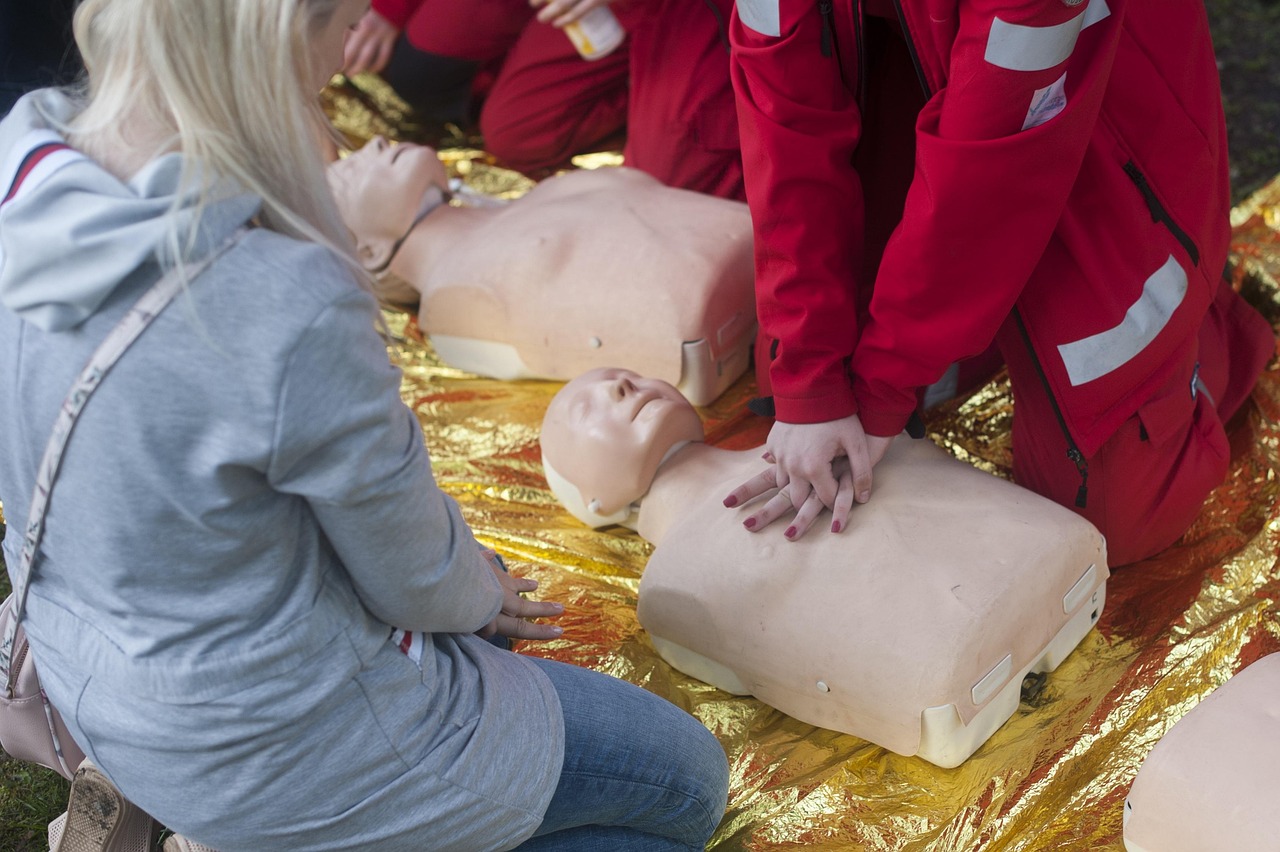
When a heart stops, the brain begins to suffer within four to six minutes, long before an ambulance can arrive. Cardiopulmonary resuscitation keeps blood and oxygen moving and buys that critical time. For an adult, push hard and fast in the center of the chest: at least two inches deep, at a rate of 100 to 120 compressions a minute, which happens to be the beat of the song “Stayin’ Alive.” Let the chest rise all the way back up between pushes. Even hands-only CPR, with no rescue breaths at all, dramatically improves survival odds and is something anyone can learn in an afternoon. If an automated external defibrillator is available, turn it on and it will talk you through every step out loud. Do not stop until help takes over or the person wakes. This is a skill you cannot improvise; you must learn it in advance.
Treat for shock
Shock is the body’s dangerous response to serious injury, blood loss, or trauma, and it can be fatal on its own even when the original injury is survivable. Learn to recognize the signs: pale, cool, clammy skin, rapid shallow breathing, a fast weak pulse, confusion, thirst, or weakness. Respond by keeping the person lying down, warm, and still. If you do not suspect a spinal, head, or leg injury, raising their legs about a foot helps blood reach the core. Cover them with a blanket or jacket to hold body heat, keep them calm, and do not give food or water, because they may need surgery later. Shock rides along with most serious emergencies, so recognizing and managing it multiplies the value of everything else you do.
Wounds, burns, and breaks
- Wounds: once bleeding is controlled, clean thoroughly by flushing with clean, drinkable water to prevent infection, which in a prolonged emergency becomes a serious threat in its own right. Dress it and keep it dry. Watch for the redness, swelling, heat, and red streaks that signal infection setting in.
- Burns: cool with clean, cool running water for a full 10 to 20 minutes, never ice, then cover loosely with a clean non-stick dressing. Do not apply butter, toothpaste, or ointments, and do not pop blisters. Any burn larger than the person’s palm, or one on the face, hands, feet, or genitals, needs professional care.
- Sprains: remember RICE: rest, ice wrapped in cloth for 20 minutes at a time, compression with a snug (not tight) wrap, and elevation above the level of the heart.
- Breaks: immobilize the injury in the position you found it, padding and splinting to prevent movement above and below the break. Do not try to realign a bone. Check that the fingers or toes past the splint stay warm and pink, and loosen it if they do not.
Reading beats doing, but a class beats both
You can learn the concepts here and from any good guide, but first aid is a physical skill, and there is no substitute for hands-on practice. A single in-person first aid and CPR class, widely available and inexpensive through the Red Cross, the American Heart Association, or your local fire department, will make you far more capable than hours of reading, because you will have actually felt the compressions, wrapped the bandage, and practiced the moves under a little pressure. If you do one thing after reading this, sign up for a class. It is the highest-return investment in all of preparedness.
Build the kit to match the skills
Skills come first, but they need supplies to apply. A genuinely stocked first aid and trauma kit puts the tools in your hands, and knowing your household’s specific medical needs rounds out your medical preparedness. From here, the next steps up are advanced first aid for serious injuries and knowing how to manage illness and infection when a doctor is not reachable.
Quick questions
Isn’t a tourniquet dangerous? Won’t it cost someone their limb? That fear is outdated. Battlefield and trauma experience shows a tourniquet can stay on for two hours or more with little risk to the limb, while catastrophic bleeding kills in minutes. For life-threatening limb bleeding, use it and do not second-guess.
How long do I keep doing CPR? Until the person wakes and breathes on their own, an AED or trained help takes over, or you are physically unable to continue. Do not keep stopping to check for a pulse; uninterrupted compressions are what matter.
Is first aid for children different? The priorities are identical, but the technique changes: gentler, shallower compressions, and for an infant you use two fingers rather than two hands. If you have young kids, a pediatric-focused class is well worth the afternoon.
Core first aid skills, condensed
- Work the order: bleeding, airway, breathing, shock.
- Stop severe bleeding with firm, sustained pressure. Train on tourniquets.
- Clear a choking airway with abdominal thrusts; know the recovery position.
- Learn CPR, even hands-only, at 100 to 120 pushes a minute. You cannot improvise it.
- Recognize and treat shock; it accompanies most serious injuries.
- Clean wounds to prevent infection; cool burns with water; immobilize breaks.
- Take a hands-on class. It beats any amount of reading.
This is general first aid information to help you learn and prepare, not medical advice or a substitute for professional care and hands-on training. Whenever emergency services are reachable, call them first.
The gear in your closet cannot help a bleeding child, but your trained hands can. Basic first aid turns you from a bystander into the person who acts in the minutes that decide an outcome. Learn these skills, take the class, keep the kit stocked, and you become genuinely useful in exactly the emergencies your family is most likely to face.