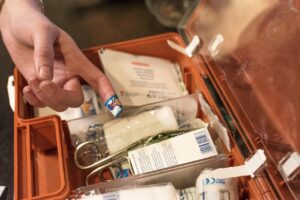
The best first aid kit is the one you have with you, but sooner or later someone gets hurt when the kit is back at camp, in the other vehicle, or long since used up. Knowing how to improvise care from what your surroundings provide is the skill that fills that gap. This is not a replacement for a real kit and real training; it is the backup for the day the kit is not there. Used wisely, ordinary materials and a little knowledge can control bleeding, immobilize a break, and keep a wound clean until proper help is reached.
The first rule of improvised care
Improvisation carries real risk of infection, so cleanliness matters more, not less, when you are working without sterile supplies. Whatever you use as a dressing or bandage should be the cleanest material available, and your priority is always to stabilize the person and get them to real medical care, not to play doctor in the field. Natural first aid buys time and prevents a bad situation from becoming worse. It does not replace a hospital, and treating it as if it does is how people get hurt.
Improvised bleeding control and bandages
The principle for bleeding never changes, kit or no kit: firm, direct, sustained pressure. What changes is what you press with. A clean shirt, a bandana, or any cloth folded into a thick pad works. Strips of clean fabric become bandages to hold a dressing in place. If blood soaks through, add more on top and keep pressing rather than pulling the soaked pad off.
In a true limb-threatening emergency, you can improvise a tourniquet, and doing it well matters. Use a strip of cloth at least an inch or two wide, never thin cord or wire, which cuts into flesh and does not work. Tie it high on the limb above the wound, slip a sturdy stick under the knot as a windlass, and twist until the bleeding stops. Tie the stick in place so it cannot unwind, and note the time out loud and in writing. Like any tourniquet, it is only for bleeding that threatens life, and once applied it stays on until real medical care takes over. It will hurt, and that is acceptable when the alternative is bleeding out.
Splints and slings from the landscape
A broken or badly sprained limb needs immobilization, and the materials are all around you. Straight, sturdy sticks padded with soft material make splint rails; strips of cloth or cordage bind them. A jacket or shirt becomes a sling for an injured arm. The goal is to prevent movement of the joint above and below the injury, cushioning the limb and securing it firmly but not so tightly that you cut off circulation. After you tie it off, press a fingernail or toenail past the splint until it whitens; if the color does not return within a couple of seconds, the binding is too tight and must be loosened. For a sprain rather than a break, the field version of RICE still applies: rest it, cool it in a stream if you can, wrap it with light support, and keep it raised.
Cleaning wounds without a kit
Infection is the great danger of any wound treated in the field, so cleaning comes first. The best tool is clean water, ideally water you have purified by boiling or filtering, used under pressure to irrigate and flush debris out of the wound. Cooled boiled water poured from a height, or squeezed from a plastic bag with a pinhole, does the job. Avoid packing a deep wound with unknown plant material, which sounds resourceful but usually introduces the very contamination you are trying to prevent. Clean it, cover it with the cleanest cloth you have, and keep it protected and dry. Raw honey, if you happen to carry it, is a genuine traditional wound dressing with real antibacterial properties, but clean water and a clean cover come first.
Keeping warm: shock and exposure
Out in the elements, two quiet killers stalk any injury: shock and the cold ground. A hurt person lying still loses heat fast, and cold deepens shock. Get an insulating layer under them, a pile of leaves, a pack, a jacket, anything that breaks contact with the ground, then cover them to hold body heat. Keep them lying down, calm, and still, and if no head, spine, or leg injury is suspected, raise the legs slightly. Managing warmth and shock in the field often matters as much as treating the wound itself.
| Field material | Safe improvised use |
|---|---|
| Clean shirt or bandana | Bleeding pad, wound cover, sling |
| Strips of clean cloth | Bandages, splint ties, wide tourniquet band |
| Straight padded sticks | Splint rails for a break or bad sprain |
| Purified (boiled) water | Flushing and irrigating wounds |
| Pack, leaves, jacket | Ground insulation against shock and cold |
A word on natural remedies
There is a long tradition of plant-based first aid, and some of it has genuine merit, but the wilderness is the worst place to experiment. Misidentifying a plant can turn a first aid attempt into a poisoning. If you want to use botanical remedies, learn them thoroughly and safely in advance, at home, from reliable sources, which is the subject of herbal remedies and natural first aid for the home. Knowledge built calmly beforehand is safe; guessing in an emergency is not.
A backup kit that fits anywhere

Affiliate note: buy through this link and ThisTracks may earn a small commission at no extra cost to you. We only list gear that is in stock and that we would carry ourselves.
Improvisation supports skill, it does not replace it
Every technique here works far better in the hands of someone who already understands proper first aid, because improvisation is really just applying core principles with substitute materials. Build the underlying knowledge through basic first aid skills and a hands-on class, and then the ability to improvise becomes a genuine backup rather than a guess. The person who knows how to treat a wound properly can do a passable job with a clean shirt; the person who does not will struggle even with a full kit.
Quick questions
Can I really improvise a tourniquet that works? Yes, with a wide cloth band and a windlass stick, twisted until the bleeding stops and tied off. What fails is thin cord, shoelaces, or a band that is not tightened enough to actually halt the flow. A purpose-built tourniquet is far better, which is why one belongs in every real kit.
Should I use spider webs or moss on a wound like in the old stories? No. Those traditions introduce dirt and bacteria into exactly the place you are trying to keep clean. The infection risk outweighs any benefit. Clean water and a clean cover are the field standard.
Natural first aid, condensed
- It is a backup for when the kit is gone, not a replacement for kit or training.
- Cleanliness matters more without sterile supplies; stabilize and seek real care.
- Bleeding: firm pressure with the cleanest cloth; a wide-band windlass tourniquet for life-threatening limb bleeds.
- Splints and slings come from sturdy sticks, padding, and strips of cloth; check circulation after tying.
- Clean wounds with purified water; insulate the injured from the cold ground.
- Learn any plant remedies safely in advance, never by guessing in the field.
This is general information for learning and preparation, not medical advice. Improvised care is a last resort; reach professional medical help whenever it is possible.
The land can lend you a splint, a bandage, and a sling when your supplies run out, but only if you already understand what you are trying to do. Learn real first aid, carry a small kit so you are rarely without one, and keep improvisation in your back pocket as the skill that covers the worst-case gap. That layered approach is what keeps a backcountry injury from becoming a backcountry tragedy.