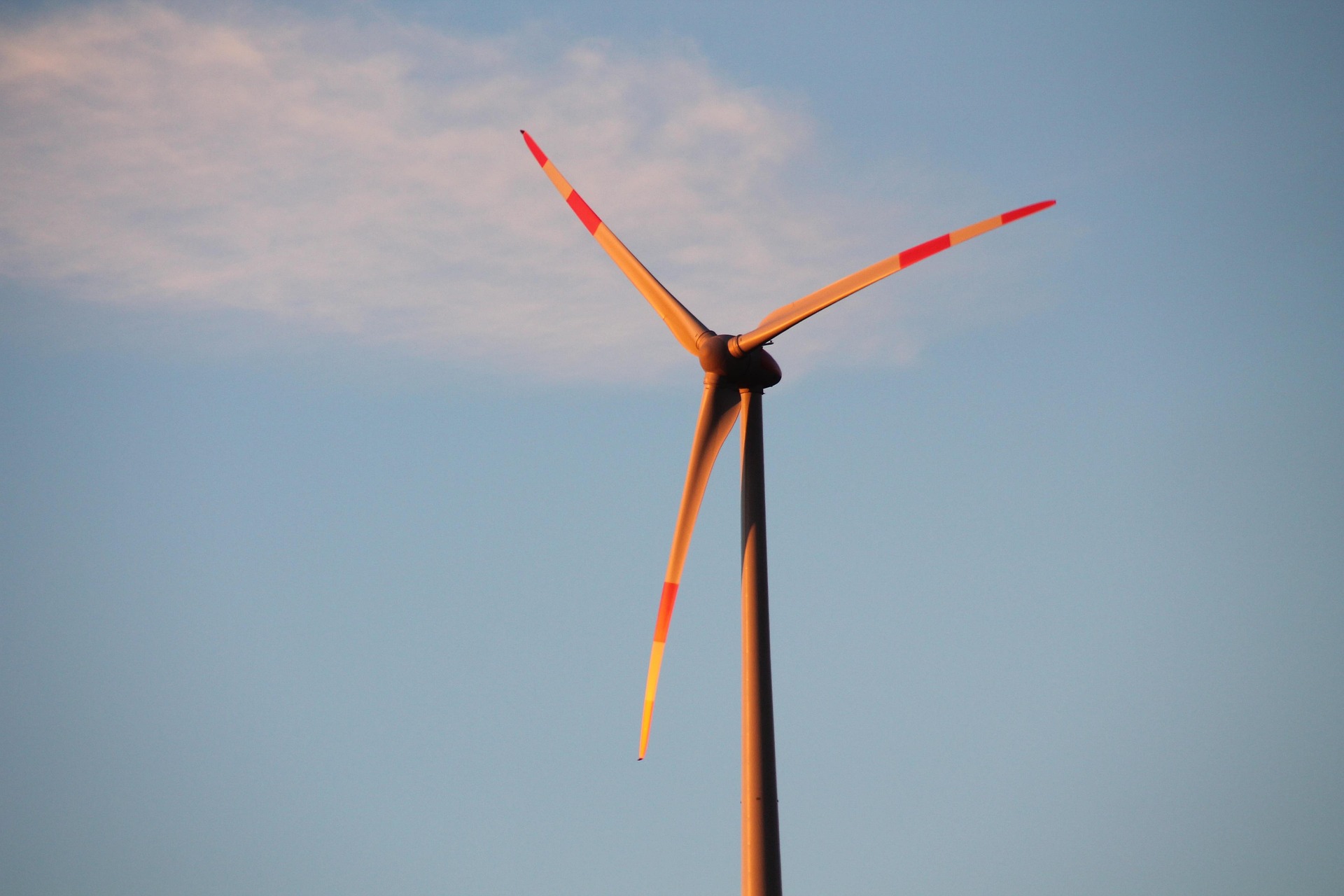
Solar gets most of the attention in off-grid power, but for the right property, a small wind turbine can be a valuable addition or even a primary energy source. Wind has one great advantage over solar that makes the two natural partners: it often blows hardest at night and in winter, exactly when solar production drops. Understanding when small-scale wind makes sense, and when it does not, saves you from an expensive disappointment and helps you build a genuinely resilient power system. This guide gives you a clear-eyed look at small wind power.
How small wind works, and what it needs
A small wind turbine works on a simple principle: wind spins a rotor connected to a generator, producing electricity that, like solar, is regulated by a charge controller, stored in batteries, and converted by an inverter for household use. It slots into the same system architecture as solar, which is why the two combine so easily. But wind has one demanding requirement that determines everything: it needs consistent, adequate wind, and this is where most small wind projects succeed or fail.
Be brutally honest about your wind resource
The single biggest reason small wind turbines disappoint is that people install them where there simply is not enough steady wind. Turbine power rises dramatically with wind speed, roughly with the cube of it, so a site averaging half the wind speed of a good one can produce as little as an eighth of the power, not half. A site with light or gusty, turbulent wind produces far less than people expect, often not enough to justify the cost. Before investing, honestly assess your wind resource: do you have open, unobstructed exposure and consistent wind, or are you in a sheltered, tree-lined, or built-up area where wind is light and turbulent? Turbulence from nearby trees and buildings is especially harmful, which is why turbines need to be mounted high on a tower, well above obstructions, to reach clean, strong wind. If your site does not have a genuinely good wind resource, your money is almost always better spent on more solar. Wind rewards the right location and punishes the wrong one, so this assessment is the make-or-break step.
Assessing your site before you spend anything
Before buying a turbine, gather real information rather than guessing. Look at regional wind resource maps, many state energy offices and the U.S. Department of Energy publish average wind speed data by area, and treat those as a starting estimate rather than a guarantee for your exact spot. Talk to neighbors with turbines or tall antennas if any exist nearby. Ideally, mount an inexpensive anemometer at your intended tower height for several months to a year and log actual readings, since local terrain can make a huge difference from what a regional map suggests. Skipping this step and buying a turbine on hope alone is the single most common and most expensive mistake in small wind.
| Site characteristic | What it means for you |
|---|---|
| Open, flat, or coastal land | Best candidate for wind; less turbulence, higher average speeds |
| Hilltop or ridge exposure | Often excellent; wind accelerates over high points |
| Wooded or suburban lot | Usually poor; turbulence from trees and buildings kills output |
| Valley or sheltered site | Generally weak wind; solar is almost always the better investment |
Where small wind shines
Given the right conditions, small wind offers real advantages. It generates power day and night, unlike solar, and it often peaks in winter and during storms when solar is weakest and your power needs may be highest. This complementary timing is its greatest strength: a combined solar and wind system produces power across more conditions than either alone, smoothing out the gaps and reducing how much battery storage you need to ride through lean periods. For a remote property with a strong, steady wind resource, wind can be the most productive renewable option available.
The realities and drawbacks
Small wind comes with trade-offs solar does not have. Turbines have moving parts that wear and require maintenance, unlike static solar panels, and bearings, blades, and yaw mechanisms typically need inspection at least annually. They need a tower, which adds cost and complexity and may face zoning restrictions and height limits, so check your local land use rules before committing. They can produce noise and vibration, and they raise concerns about wildlife in some settings. And a quality turbine and tower represent a significant investment, often comparable to or higher than an equivalent solar array before you even account for the tower. These are not reasons to avoid wind, but reasons to go in informed, so the system meets expectations.
Part of a resilient energy mix
The best way to think about small wind is not as a competitor to solar but as a potential partner in a diversified, resilient power system. Just as financial resilience comes from diversification, energy resilience comes from multiple sources that fail at different times. For a property with good wind, combining wind with solar, and where possible micro-hydro, creates a robust system that keeps producing across seasons and conditions. This diversified approach is the heart of serious off-grid living and a strong hedge against a grid failure.
Common questions
How do I know if my average wind speed is actually good enough?
As a rough rule of thumb used in the small wind industry, an average annual wind speed below about 9 mph at hub height rarely justifies a turbine economically, while sites averaging 11 to 12 mph or more are strong candidates. These are general benchmarks, not guarantees, which is exactly why on-site measurement over several months beats relying on a regional average alone.
Can I combine a small turbine with an existing solar system?
Yes, and it is one of the more common and effective setups for off-grid properties with good wind. Both typically feed into the same battery bank through their own charge controllers, and a hybrid inverter or a compatible pairing of components lets the two work together smoothly. Consult with whoever designs or installs your system to make sure the components are rated to work together safely.
Is a small wind turbine ever a bad idea even with decent wind?
Yes, if local zoning prohibits the tower height needed to clear surrounding obstructions, or if neighbors are close enough that noise becomes a real dispute. A turbine mounted too low to escape turbulence, often to avoid a zoning height limit, frequently underperforms so badly that it never recoups its cost, which is worse than not installing one at all.
Small-scale wind, condensed
- Wind uses the same system architecture as solar: controller, batteries, inverter.
- It lives or dies by your wind resource. Assess it honestly, ideally with on-site measurement, before investing.
- Mount turbines high on a tower, well above trees and buildings, for clean wind.
- Wind’s strength is producing at night and in winter, complementing solar.
- Expect maintenance, towers, zoning rules, and real cost; go in informed.
Small-scale wind power is a genuine option for energy independence, but it is far more site-dependent than solar, rewarding properties with a strong, steady wind resource and disappointing those without one. If your land has the wind, a turbine can be a powerful complement to solar, producing when the sun does not and building a more resilient system across all seasons. Assess your site honestly, respect the requirements, and treat wind as one part of a diversified renewable mix, and it can earn a valuable place in your journey toward self-reliant power.